Is vasectomy reversible?
Yes, in many cases it can be attempted. Vasectomy cuts the vas deferens and the more time passes, the more difficult it is to reverse. Thanks to modern microsurgery, it is possible to reconnect these ducts and restore natural fertility in a good number of patients.
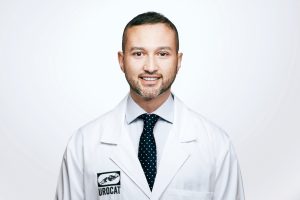
Dr. Malca, specialist in Urology and Andrology at UROCAT, explains that:
“Vasovasostomy is a microsurgical technique that allows the vas deferens severed during vasectomy to be reconnected, with the aim of recovering the passage of sperm and, with it, the possibility of a natural pregnancy.”
What is vasovasostomy and in what cases is it indicated?
Vasovasostomy rejoins the ends of the vas deferens with very fine sutures visible only under a surgical microscope. It is indicated in cases of desire to have children with a new partner, family expansion or, in selected cases, post-vasectomy testicular pain. If many years have passed or the female partner has a low ovarian reserve, it may be more appropriate to directly evaluate assisted reproduction.
Dr. Malca, specialist in Urology and Andrology at UROCAT, explains that:
“Not all patients request reversal for reproductive reasons. In selected cases, vasovasostomy is also considered as a treatment for chronic post-vasectomy pain, although the indications must be very carefully evaluated.”
How does the surgery work?
Vasovasostomy is performed in the operating room under general or regional anesthesia and lasts between 1 and 3 hours. The surgeon makes a small incision in the scrotum, identifies the ends of the duct and reconnects them with microscopic sutures. If there is obstruction in the epididymis, a more complex technique may be required: vasoepididymostomy. The patient returns home the same day or the next day.
Real probability of natural pregnancy
Surgical success (reappearance of sperm) is not the same as reproductive success (achieving pregnancy). The odds depend greatly on the time elapsed:
Time since vasectomy | Probability of pregnancy |
Less than 3 years old | ~76% |
Between 3 and 8 years old | ~53% |
Between 9 and 14 years old | ~44% |
15 years or older | ~30% |
Dr. Malca, specialist in Urology and Andrology at UROCAT, explains that:
“Within less than three years, we can talk about a 76% probability of pregnancy. With more than fifteen years, it drops to around 30%. But even in these cases, vasovasostomy can be a real and valid option, depending on the context of the couple.”
Factors that influence fertility recovery
- Time since vasectomy:
- Surgical technique: specialized microsurgery offers better results.
- Fertility of the female partner: age and ovarian reserve are determining factors.
- Intraoperative findings: epididymal obstruction may require vasoepididymostomy.
Dr. Malca, specialist in Urology and Andrology at UROCAT, explains that:
“Results depend on the time since the vasectomy, the quality of the microsurgical technique, the fertility of the female partner and what we find at the time of the intervention. That is why an individualized assessment is so important.”
Alternatives if reversal is not possible
When vasovasostomy is not feasible, sperm can be obtained directly from the testicle or epididymis for use in in vitro fertilization (IVF-ICSI).
When is each option recommended?
- Short time since vasectomy and good female fertility → assess vasovasostomy.
- Long time since vasectomy or limiting female factors → consider IVF-ICSI.
- Older female partner → IVF can be faster and more efficient.
The choice requires a joint assessment between Urology, Andrology and assisted reproduction.
Recovery after surgery
In the first few days it is normal to notice swelling and mild discomfort. Relative rest and the use of a jockstrap help. Daily activity is resumed in 1–2 weeks and sexual intercourse is recommended to wait 3–4 weeks.
Periodic seminograms are then performed to monitor the reappearance and quality of the sperm. The risks are rare: local infection, hematoma or late re-obstruction of the duct.
When to consult UROCAT?
If you have had a vasectomy and want to know if reversal is an option for you, the first step is a specialized consultation. At UROCAT we offer you:
- Personalized assessment of your case.
- Realistic analysis of the probabilities of success.
- Multidisciplinary approach: Urology, Andrology and fertility.
Request a visit with the UROCAT Urology and Andrology service and receive an expert medical assessment adapted to your situation.
Frequently asked questions
1. How does reversible vasectomy work and what is done during vasovasostomy?
A surgical microscope is used to very precisely align and suture the vas deferens cut during the vasectomy, so that the sperm can pass back into the semen.
2. Why is pregnancy not always achieved, even if the surgery goes well?
Pregnancy depends on the quality of the retrieved semen, the age and fertility of the female partner, and the length of time she has been trying to conceive. Surgical success does not automatically guarantee pregnancy.
3. When should I consult a specialist?
Whenever you have a real desire to restore fertility, it’s best to do it early. An early assessment allows you to compare options and choose the best strategy for you and your partner.
Author